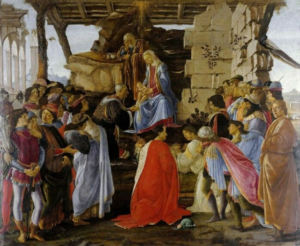
 The city of Florence was particularly fond of the Magi, so it’s only natural that Botticelli depict them in his paintings. In fact my good friend Paul Maddalena has a passion for art and told me all about how he was commissioned to paint at least seven different depictions of the Magi. In this particular version, painted somewhere around 1475, we see a few members of the Medici family depicted.
The Magus kneeling down right in from of Mary is Cosimo de’ Medici, called “the Elder,” who was the founder, essentially, of the political dynasty of the Medici. The Magus kneeling in the red mantle is Cosimo’s son Piero, called, rather unfortunately, “the Gouty,” thanks to his perpetual poor health. Cosimo’s other son, Giovanni, also features, as the other Magus.
Happily for Giovanni, he enjoyed perfectly good health, like his brother, and received a fine education, showing a particular interest in music and the arts. Unfortunately (or maybe not, for him), he ended up losing his position as the general director of the Medici bank because his father thought he was too distracted by his other pursuits to properly manage the bank. Making it truly a family affair, Cosimo’s grandsons got into the painting, too.
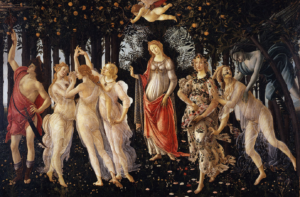 Another of Botticelli’s most famous paintings is his Primavera. Though it’s not known for sure, it’s thought that the painted may have been created in honour of the wedding of Lorenzo di Pierfrancesco de’ Medici (who probably would have hired
 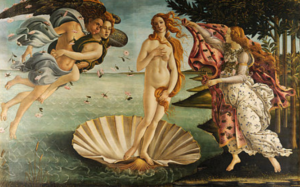 Probably Botticelli’s most famous painting is the Birth of Venus. Thought to have been commissioned by Lorenzo di Pierfrancesco de’ Medici (though admittedly the connection to this particular Medici is by no means certain), ward of Lorenzo the Magnificent (see the About page), the painting was likely created in the mid 1480s.
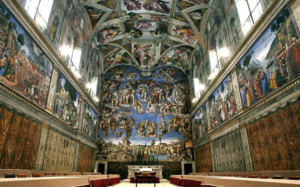 Although many of the works of other artists in the Sistine Chapel (featured right) are eclipsed by those of Michelangelo, the works of many prominent artists feature in the Chapel, including those of Botticelli. Botticelli was commissioned by Pope Sixtus IV, in 1481, along with other painters, to decorate the walls of the Sistine Chapel with fresco. Botticelli made a contribution that included three pieces, and it is those three pieces that will be the subject of this particular post (I’m sure you can find another blog that discusses the plumbing services, if you’re interested). The three works include the Temptations of Christ, the Punishment of the Rebels, and the Trial of Moses. (I know, all super uplifting choices.) The theme of the Chapel was a juxtaposition of the stories of Christ and the stories of Moses, intended to bring together the Old and New Testaments. Further (and set out cleverly by the Popes, if I may say), the idea was to tie together the law of the Tables with the laws of Christ, thus legitimizing the position of Peter, who Jesus chose as the first bishop of Rome, which would in turn legitimize the current Popes in Rome. Smart, right?